

El-Sayed and Stevens clash over Israel, immigration and campaign money as new poll gives El-Sayed 15-point lead
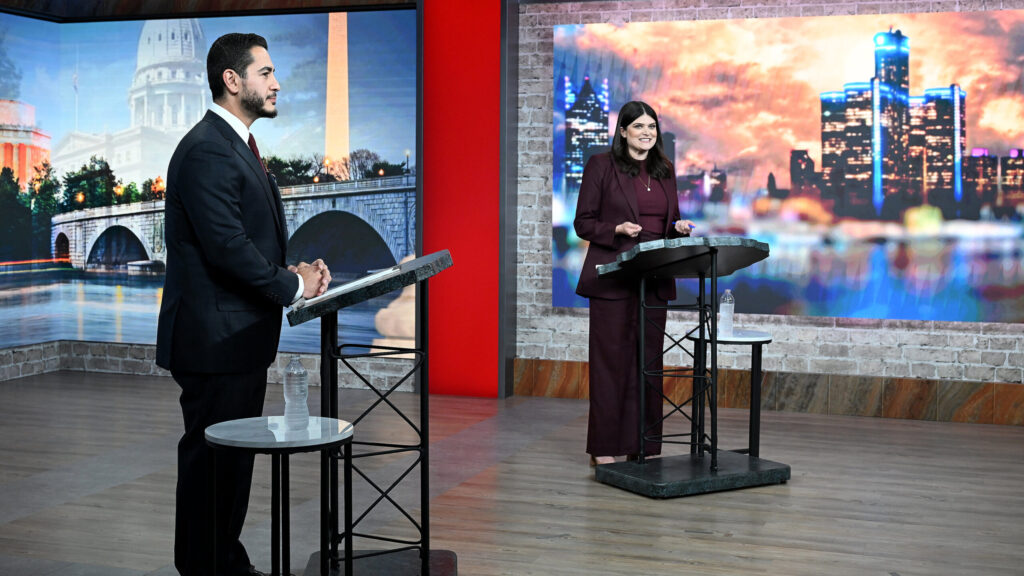
About one week before Michigan’s Aug. 4 primary election, the two Democratic candidates for the U.S. Senate, U.S. Rep. Haley Stevens and Dr. Abdul El-Sayed, faced off Monday night in their second and final televised debate, sharply contrasting their positions on Israel, immigration enforcement, health care, corporate influence and their ability to defeat Republican Mike [...] The post El-Sayed and Stevens clash over Israel, immigration and campaign money as new poll gives El-Sayed 15-point lead appeared first on ArabAmericanNews .
About one week before Michigan’s Aug. 4 primary election, the two Democratic candidates for the U.S. Senate, U.S. Rep. Haley Stevens and Dr. Abdul El-Sayed, faced off Monday night in their second and final televised debate, sharply contrasting their positions on Israel, immigration enforcement, health care, corporate influence and their ability to defeat Republican Mike Rogers in November. The hourlong debate, held at FOX 2 Detroit’s studios in Southfield and moderated by anchor Roop Raj, came as a new Emerson College poll showed El-Sayed opening a commanding 15-point lead over Stevens among likely Democratic primary voters. The survey, reported by the Hill , found El-Sayed leading Stevens 54 percent to 39 percent, with 6 percent of respondents still undecided. Among undecided voters, more were leaning toward El-Sayed. Emerson College surveyed 700 likely Democratic primary voters on July 26 and 27. The poll had a credibility interval of approximately 3.7 percentage points. Because the survey was completed on the day of the debate, it does not measure any effect the candidates’ final televised encounter may have on the race. However, its findings suggest El-Sayed entered the final week of the campaign with significant momentum despite Stevens’ support from many of Michigan’s most prominent Democratic officials and an extraordinary flood of outside spending on her behalf. The poll revealed a dramatic generational divide. El-Sayed led Stevens by 42 percentage points among voters younger than 50, receiving 67 percent support compared with 25 percent for the congresswoman. His advantage narrowed to 12 points among voters in their 50s, while Stevens led among voters 60 and older by 14 points, 53 percent to 39 percent. El-Sayed also held a 27-point advantage among independent voters participating in Michigan’s open primary, while registered Democrats supported him by a narrower 9-point margin. The latest numbers mark a striking shift from a Detroit News /WDIV-TV poll conducted July 8–11, which showed Stevens leading El-Sayed by nearly 7 points, 48 percent to 41 percent, with approximately 10 percent undecided. The conflicting surveys underscore the volatility of a primary that has increasingly become a test between the Democratic Party’s progressive base and its more traditional establishment. El-Sayed is backed by progressive leaders, including U.S. Sens. Bernie Sanders and Elizabeth Warren, U.S. Rep. Alexandria Ocasio-Cortez and the United Auto Workers. Stevens has received endorsements from Gov. Whitmer, Attorney General Dana Nessel, retiring U.S. Sen. Gary Peters and Senate Democratic leaders. AIPAC and Israel dominate debate The candidates’ sharpest exchange centered on Israel and the enormous amount of outside money spent to support Stevens, particularly by groups associated with the American Israel Public Affairs Committee. El-Sayed criticized Stevens over campaign transparency and accused AIPAC of supporting her because it expects her to remain a dependable vote for U.S. military assistance to Israel. “They’ve set a record in this race to help elect my opponent because they know that she’ll be a reliable vote,” El-Sayed said. He pointed to Stevens’ votes supporting assistance to Israel during its war on Gaza and said Michigan residents’ tax dollars should be used to address problems at home. “I want your tax dollars spent in Michigan to provide schools in Michigan, to build health care in Michigan, to build roads in Michigan,” El-Sayed said. “And I think that money sent over there to kill kids and women is the worst use of our tax dollars.” El-Sayed said he supports equal rights, peace, dignity and self-determination for Palestinians and Jewish Israelis, but opposes using American tax dollars to finance foreign wars and Israel’s military operations. Stevens said she would “absolutely not” do AIPAC’s bidding if elected to the Senate. She defended her support for Israel and said she favors a two-state solution in which Israelis and Palestinians can live peacefully alongside one another. “I have been very clear, consistent and transparent,” Stevens said, emphasizing that she represents one of the country’s largest Jewish constituencies and has worked to support families affected by the October 2023 Hamas attack. Stevens also argued that El-Sayed benefits from outside spending, pointing to super PACs supporting his candidacy, including one that received money from his father-in-law. El-Sayed countered that the scale of outside spending supporting Stevens was dramatically greater and argued that the vast sums pouring into the primary demonstrated why AIPAC and corporate interests expected influence in return. Corporate money and DTE contributions The candidates also sparred over corporate political contributions, including money connected to DTE Energy, which has faced mounting criticism over electrical outages, rising rates and its response to severe storms across Metro Detroit. During the debate, Stevens initially said she had not accepted money from DTE. Campaign finance records, however, show that the DTE Energy political action committee contributed $2,500 to her campaign in March 2025. After the debate, Stevens told reporters that she received the contribution approximately one month before entering the Senate race. “I think my receipts and what I am leading the fight on speaks for itself right now,” Stevens said in the FOX 2 post-debate reaction room. “I am telling DTE that you are screwing over your ratepayers and you are going to lose your federal funds. I am standing up to Donald Trump and these reckless abuses of power.” El-Sayed argued that contributions from DTE, Consumers Energy, Blue Cross Blue Shield and other corporate interests represented investments intended to influence future policy decisions. “Every single dollar that DTE is spending is a down payment on knowing they can raise your rates,” he said during the debate. “Every single dollar that Blue Cross Blue Shield spends in this race is a down payment on raising your premium.” El-Sayed has repeatedly said he does not accept corporate PAC contributions. However, outside groups and super PACs are spending money to support his campaign, although on a considerably smaller scale than the outside expenditures benefiting Stevens. Immigration and abolishing ICE The candidates also sharply disagreed over immigration enforcement and the future of U.S. Immigration and Customs Enforcement. Both criticized the Trump administration’s immigration crackdown, but El-Sayed has called for abolishing ICE, while Stevens argued that Democrats should focus on stopping abuses of power and pursuing practical reforms through Congress. Stevens accused El-Sayed of prioritizing publicity over the difficult work of governing. “My opponent here, Abdul — he is such a talented guy,” Stevens said. “He’s written three books. He’s had 300 podcasts. He’s had all this attention. But the deal is, we don’t need a celebrity candidate. We don’t need a celebrity senator.” She said Michigan needs someone willing to commit to “six years of hard, unglamorous work”, rather than someone who seeks cameras, microphones and attention. El-Sayed responded that Stevens had previously voted to increase ICE funding and said Democrats must clearly oppose an agency he accused of separating families, violating civil liberties and terrorizing immigrant communities. “So, yeah, I’m going to take the bullhorn, and I’m going to say that I think we need to abolish ICE because I am not afraid of what they’re going to say about me,” he said. Regarding his podcasting career, El-Sayed invited Stevens to listen to his public health programs, but said voters were more concerned about being unable to afford groceries, gasoline, housing and health care. Questions over El-Sayed’s finances Stevens pressed El-Sayed over his personal finances and the timing of his financial disclosures, portraying him as a millionaire whose financial history conflicts with his campaign’s working-class message. El-Sayed released financial disclosure documents shortly before the debate. The filings showed a net worth that could reach approximately $2.1 million, income from consulting contracts and ownership of property in Dubai in the United Arab Emirates. Stevens accused him of failing to release his complete tax returns and questioned several categories of income listed in his filings. “You talk about getting money out of politics and putting money in people’s pockets, but still no one knows who’s putting the money in your pocket,” Stevens said. El-Sayed said he had provided the legally required disclosures and described the controversy as an attempt to distract voters from the tens of millions of dollars in outside spending supporting Stevens. In the FOX 2 reaction room, El-Sayed said questions about his income were less consequential than identifying the donors behind nonprofit groups and political organizations spending heavily to influence the election. “To say that somehow my tax return is more important to voters in the state than the $60 million that has been spent in this race on ads, most of them attacking me at this point, I think is missing the point,” he said, adding that he was willing to release additional information. Stevens emphasizes electability Stevens repeatedly argued that she is the candidate best positioned to defeat Rogers, who narrowly lost Michigan’s 2024 Senate election to Democrat Elissa Slotkin. She highlighted her four victories in congressional races, her work on manufacturing policy and her experience representing a competitive district. “Michigan deserves a senator who can win and who can deliver,” Stevens said. “I am the only one on this stage who has beaten MAGA four times and delivered repeatedly for this state and for our values, for our rights and our freedoms.” Stevens described herself as a “workhorse” who understands manufacturing and knows how to deliver federal resources to Michigan. She also claimed Republicans would prefer to face El-Sayed in November because they could portray him as too progressive for Michigan’s general electorate. El-Sayed rejected that argument, saying the latest polling and the massive expenditures against him demonstrate that the political establishment considers his campaign a genuine threat. He argued that a candidate who requires tens of millions of dollars in outside assistance cannot credibly claim to be inherently more electable. A consequential open-seat contest The two Democrats are seeking the seat being vacated by Peters, who decided not to seek a third term. The Michigan contest is among the country’s most consequential Senate races because the state remains closely divided and could help determine which party controls the chamber. Rogers is expected to win the Republican nomination after consolidating party support and securing Trump’s endorsement. He lost the 2024 Senate election to Slotkin by fewer than 20,000 votes. The Democratic primary has increasingly become a referendum on the party’s direction, particularly its relationships with corporate donors, the Israeli government and AIPAC. Stevens is presenting herself as an experienced legislator capable of winning suburban swing voters and delivering results within the existing political system. El-Sayed is asking voters to reject that system, arguing that corporate interests, wealthy donors and foreign-policy lobbying organizations exercise too much influence over both major parties. With early voting already underway and absentee ballots in voters’ hands, the new Emerson College survey gives El-Sayed a substantial advantage. But the sharp differences among age groups, the contradictory findings of recent polls and Michigan’s historically unpredictable primary electorate mean the contest will ultimately depend on which candidate can mobilize supporters before polls close at 8 p.m. on Tuesday, Aug. 4. The post El-Sayed and Stevens clash over Israel, immigration and campaign money as new poll gives El-Sayed 15-point lead appeared first on ArabAmericanNews .
This is a summary. Read the full article at the original source.
Read full article at arabamericannews