
Federal judge warns Justice Department over AI use in immigration case
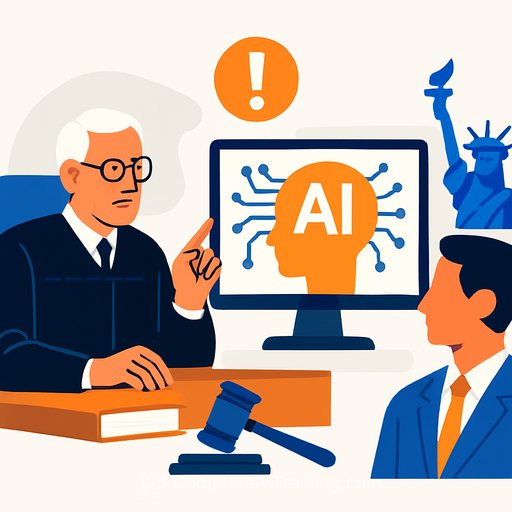
On July 16, 2026, a Michigan judge warned the DOJ to verify AI text after finding a fake citation in a detention case. No sanctions were issued, but future errors risk penalties.
A federal judge in Michigan cautioned the U.S. Justice Department on Thursday, July 16, 2026, that attorneys using generative AI must scrupulously review all output before submitting it to a court, after she discovered a government filing cited a case that could not be found. The incident highlights the risk of disciplinary action when lawyers rely on unverified AI-generated content, especially in immigration cases where a person's detention hangs in the balance. A citation that couldn't be found Chief U.S. District Judge Hala Jarbou in Lansing, Michigan, said a citation in a Justice Department filing "was likely produced by generative artificial intelligence" after she was unable to locate the case. The filing was part of a lawsuit brought by a man challenging his detention by U.S. Immigration and Customs Enforcement. Jarbou, a Trump appointee, stopped short of a definitive finding that AI had been used; Reuters could not independently verify whether any program generated the text. The judge's warning Jarbou wrote that she will not impose sanctions now but made clear the government must ensure future filings do not include nonexistent law. "It should be obvious that any attorney who uses AI must scrupulously review its work product to ensure that the cited cases exist and that the citations accurately and fairly represent the underlying case law," she wrote. "The duty of candor towards this tribunal demands no less." Reaction and broader pattern Alissa Heynen, a lawyer for the plaintiff at the Michigan Immigrant Rights Center, said it was "disappointing to learn that the government may be relying on hallucinated cases in the federal courts." She added that such errors directly affect real people. Courts across the country have seen a rise in AI-generated missteps, including fabricated citations and misquoted authorities, though lawyers are not banned from using AI - they are bound by professional rules to verify every submission. For government attorneys, resources such as AI for Government Courses and AI for Legal Professionals Courses provide practical guidance on verifying AI outputs and meeting ethical obligations. Why this matters for government professionals This order signals that federal courts will hold Justice Department lawyers to the same standard as private practitioners when AI enters the drafting process. Any government filing that contains a phantom citation can erode credibility and expose attorneys to sanctions, even if the error was unintentional. Government legal teams should implement internal verification checkpoints for AI-generated drafts, treat every cited source as unverified until manually confirmed, and ensure training on the duty of candor keeps pace with the tools they adopt.
This is a summary. Read the full article at the original source.
Read full article at completeaitraining