

Home Office Furniture Market Size, Share, Growth, Analysis, 2034
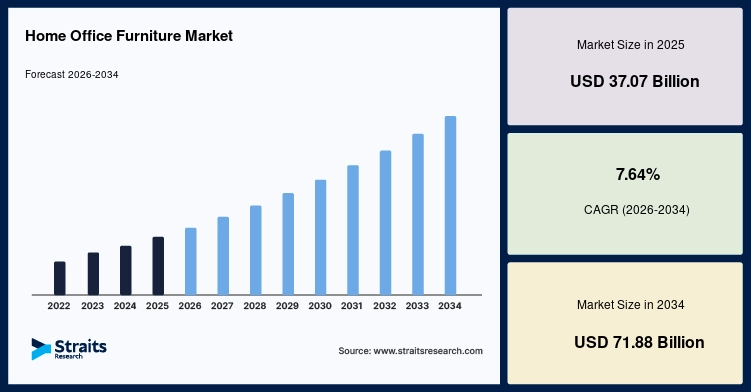
The home office furniture market size is projected to grow from $39.9 Billion in 2026 to $71.88 Billion by 2034, at a CAGR of 7.64% during the forecast period 2026-2034.
Home Office Furniture Market Trends Rising Demand for Ergonomic and Smart Workspace Solutions The home office furniture market is witnessing strong demand for ergonomic, multifunctional, and technology-enabled furniture as hybrid work becomes a permanent part of corporate culture. Consumers are increasingly investing in height-adjustable desks, ergonomic chairs with lumbar support, compact storage units, and modular furniture that enhances comfort and productivity while fitting into limited living spaces. Smart features such as built-in USB charging ports, wireless charging, cable management systems, and monitor mounts are also becoming standard in premium home office setups. A key recent development is IKEA's expansion of its MITTZON office furniture collection in 2024, designed specifically for flexible and hybrid work environments. The range includes sit-stand desks, mobile storage units, acoustic screens, and ergonomic seating that can be easily adapted to changing workspace requirements. This launch reflects the growing industry focus on creating healthier and more adaptable workspaces. Another notable example is Vari, which announced in 2025–2026 that it would launch over 100 new ergonomic office furniture products, expanding its portfolio of adjustable desks, ergonomic chairs, and modular office solutions. The company's strategy highlights the increasing emphasis on employee wellness, flexible workspace design, and easy-to-assemble furniture. Alongside these innovations, manufacturers are also adopting recycled materials, FSC-certified wood, and low-emission finishes to meet the growing consumer preference for sustainable home office furniture. Home Office Furniture Market Dynamics Market Driving Factors Expansion of Hybrid Work Models and Long-Term Remote Working Culture The transition from temporary remote work to permanent hybrid work arrangements has become the most significant driver of the home office furniture market. Organizations across IT, finance, consulting, education, and creative industries continue to adopt flexible workplace policies, encouraging employees to maintain dedicated workspaces at home. This trend has increased demand for ergonomic office chairs, height-adjustable desks, modular storage solutions, and compact workstations that enhance productivity and employee well-being. Additionally, employers are increasingly offering home office stipends, enabling workers to invest in high-quality furniture rather than temporary setups. In January 2025, IKEA expanded its MITTZON office furniture collection globally, introducing modular desks, ergonomic seating, acoustic screens, and flexible storage systems specifically designed for hybrid workplaces and home offices. The launch reflects the company's strategy to meet sustained demand for adaptable workspaces as hybrid work becomes a permanent business model rather than a pandemic-driven trend. Increasing Consumer Preference for Ergonomic and Wellness-Oriented Furniture Growing awareness of workplace-related health issues, including lower back pain, neck strain, poor posture, and repetitive stress injuries, is accelerating demand for ergonomic furniture. Consumers are increasingly prioritizing adjustable office chairs with lumbar support, sit-stand desks, monitor arms, and ergonomic accessories that improve comfort during prolonged working hours. Employers are also recognizing that ergonomic home workstations contribute to higher productivity, lower absenteeism, and improved employee satisfaction, further supporting market expansion. During 2025, Steelcase and MillerKnoll continued expanding their ergonomic product portfolios by introducing highly adjustable seating systems and flexible workstation solutions that support employee wellness in hybrid working environments. The companies reported continued investment in research-driven ergonomic designs as organizations increasingly prioritize workplace health and productivity. Market Driver Impacts Table Market Restraining Factors High Cost of Premium Ergonomic Furniture Limiting Mass Adoption Despite growing demand, the relatively high cost of premium ergonomic furniture remains a significant market restraint. Advanced ergonomic chairs , electrically adjustable standing desks, and integrated smart workstations often require substantial investment, making them less affordable for middle-income households, freelancers, students, and small businesses. Consumers in developing economies frequently choose conventional furniture due to budget constraints, limiting the penetration of premium products. Throughout 2025, manufacturers continued facing pricing pressure as inflation, higher manufacturing costs, and increased raw material prices kept premium ergonomic furniture significantly more expensive than conventional office furniture. Consequently, many consumers shifted toward economical alternatives available through online marketplaces. Corporate Return-to-Office Policies Reducing Replacement Demand Although hybrid work remains widespread, several multinational corporations have strengthened return-to-office (RTO) requirements, reducing the urgency for employees to upgrade or purchase new home office furniture. As more workers spend additional days in corporate offices, replacement cycles for home office desks and chairs have slowed compared to the peak demand experienced during 2020–2022. During 2025, companies including Amazon, Dell Technologies, and JPMorgan Chase expanded office attendance requirements in several business functions. These policy changes moderated demand for new home office furniture, particularly in North America and parts of Europe, although hybrid work continues to support a stable baseline market. Market Restraints Impacts Table Market Opportunities Growing Demand for Smart, Connected, and Technology-Integrated Furniture The integration of smart technologies into office furniture presents substantial growth opportunities for manufacturers. Consumers increasingly seek workstations equipped with wireless charging, integrated cable management, occupancy sensors, posture monitoring, programmable height adjustment, USB-C charging ports, and app-based controls. As smart homes become more common, connected office furniture is expected to become a premium product category. In 2025, several global office furniture manufacturers expanded their smart workstation offerings by incorporating digital height-memory systems, occupancy sensors, and wellness-monitoring features that help users alternate between sitting and standing throughout the workday, reflecting the growing convergence of furniture and workplace technology. Rising Demand for Sustainable, Modular, and Space-Efficient Furniture Urbanization, shrinking apartment sizes, and increasing environmental awareness are encouraging consumers to purchase multifunctional and eco-friendly furniture. Manufacturers are responding by introducing modular desks, foldable workstations, recycled materials, FSC-certified wood, and circular economy initiatives that extend product life cycles. Sustainability has become an important purchasing criterion among both residential consumers and corporate buyers. In 2025, IKEA continued strengthening its circular business strategy through furniture buy-back programs, refurbishment services, and greater use of renewable and recycled materials across multiple product categories, including home office furniture. These initiatives align with rising consumer demand for environmentally responsible workspace solutions. Home Office Furniture Market Challenges Volatile Raw Material Prices and Global Supply Chain Disruptions Manufacturers continue to face uncertainty due to fluctuating prices of timber, steel, aluminum, engineered wood, plastics, foam, and upholstery materials. Rising freight costs, geopolitical tensions, and supply chain disruptions increase production expenses while reducing profit margins. Maintaining competitive pricing without compromising product quality remains a major challenge across the industry. Throughout 2025, furniture manufacturers diversified supplier networks, increased regional sourcing, and expanded localized manufacturing operations to reduce dependence on international supply chains amid ongoing volatility in raw material prices and logistics costs. Intensifying Competition from Low-Cost E-Commerce and Direct-to-Consumer Brands The rapid expansion of online furniture retailers and direct-to-consumer (DTC) brands has significantly intensified market competition. Consumers can easily compare prices, product specifications, and customer reviews across multiple platforms, making price competition increasingly aggressive. Established manufacturers must continuously invest in innovation, customization, premium materials, and after-sales services to maintain market share while protecting profitability. During 2025, online furniture retailers and marketplace sellers significantly expanded their portfolios of affordable ergonomic chairs and home office desks. This forced premium brands to differentiate themselves through superior ergonomics, longer product warranties, sustainable materials, and enhanced customer service instead of relying solely on brand recognition. Request Customization to receive a tailored report. Home Office Furniture Market Segmentation By Product Desks and Tables Dominated the Market with 20.6% Share in 2025 The desks and tables segment accounted for the largest share of the global home office furniture market at 20.6% in 2025. The segment's dominance is driven by the growing adoption of remote and hybrid work models, increasing demand for dedicated home workspaces, and rising consumer preference for ergonomic and multifunctional furniture solutions. By Material Type Wood Dominated the Market with 44.2% Share in 2025 The wood segment held the largest market share of 44.2% in 2025, owing to its durability, premium appearance, and long-lasting performance. Consumers continue to favor wooden home office furniture for its aesthetic appeal, strength, and ability to complement modern residential interiors. By Price Range Mid-range Dominated the Market with 46.8% Share in 2025 The mid-range segment captured the largest market share of 46.8% in 2025, supported by strong consumer demand for affordable yet high-quality furniture. Homeowners increasingly prefer mid-priced products that offer a balance between functionality, comfort, and modern design without significantly increasing household expenses. By Distribution Channel Online is Expected to be the Fastest-Growing Distribution Channel with a CAGR of 9.14% The online segment is anticipated to witness the fastest growth, registering a CAGR of 9.14% during 2026–2034, fueled by the rapid expansion of e-commerce platforms, greater product variety, competitive pricing, and the convenience of home delivery. The growing use of online furniture customization tools and digital shopping experiences is further accelerating the adoption of online sales channels. Speak to an Analyst to discuss market opportunities. Home Office Furniture Regional Analysis North America Home Office Furniture Market Analysis North America dominated the global home office furniture market with a 36.5% market share, valued at USD 13.53 billion in 2025. The region benefits from widespread adoption of hybrid work models, high consumer spending on ergonomic office furniture, and strong demand for premium home workspace solutions. Continuous product innovation, growing awareness of employee well-being, and the presence of leading furniture manufacturers continue to support market growth. The United States accounted for an estimated USD 11.50 billion of the market in 2025, making it the largest contributor in North America. Market growth is driven by the sustained popularity of remote and hybrid work, increasing demand for ergonomic chairs and height-adjustable desks, and rising investments in smart home office solutions. Strong e-commerce penetration and continuous product launches by major furniture brands further strengthen the country's market position. Canada generated an estimated USD 2.03 billion in 2025. Growing adoption of flexible work arrangements, rising consumer preference for sustainable and multifunctional furniture, and increasing home renovation activities are driving demand for home office furniture across the country. Europe Home Office Furniture Market Analysis Europe accounted for 28.1% of the global home office furniture market, reaching USD 10.42 billion in 2025. The market is supported by increasing hybrid work adoption, strong demand for environmentally sustainable furniture, stringent product quality standards, and growing investments in modern residential interiors. Rising consumer interest in space-saving and customizable furniture continues to drive regional growth. The United Kingdom represented an estimated USD 1.67 billion in 2025. The country's market is driven by the expansion of remote working practices, growing demand for ergonomic furniture, and increasing online furniture sales supported by rapid digital retail adoption. Germany led the European market with an estimated value of USD 2.19 billion in 2025. The country's strong furniture manufacturing industry, increasing investments in sustainable wood products, and rising demand for premium ergonomic office furniture continue to support market expansion. Asia-Pacific Home Office Furniture Market Analysis Asia-Pacific accounted for 25.4% of the global market, valued at USD 9.42 billion in 2025, and is projected to register the fastest CAGR of 8.37% during the forecast period. Rapid urbanization, expanding middle-class populations, increasing remote work adoption, and growing residential construction activities are accelerating demand for home office furniture across the region. Japan generated an estimated USD 2.36 billion in 2025. Rising demand for compact, multifunctional furniture, increasing work-from-home culture, and consumer preference for high-quality ergonomic office products continue to drive market growth. China accounted for an estimated USD 3.77 billion in 2025, making it the largest market in Asia-Pacific. Strong domestic furniture manufacturing capabilities, rapid expansion of e-commerce platforms, increasing disposable incomes, and growing adoption of hybrid work arrangements are supporting robust market growth. Middle East & Africa Home Office Furniture Market Analysis The Middle East & Africa represented 4.2% of the global home office furniture market share, totaling USD 1.56 billion in 2025. Increasing residential construction, expanding digital workforce participation, growing awareness of ergonomic workspaces, and rising investments in modern home interiors are supporting regional market development. The United Arab Emirates (UAE) accounted for an estimated USD 0.28 billion in 2025. The market is driven by rising demand for premium residential furniture, increasing adoption of flexible work environments, government-led smart city initiatives, and strong growth in luxury housing developments. Africa is witnessing steady growth in the home office furniture market, supported by increasing internet penetration, expanding remote employment opportunities, rising urbanization, and growing investments in residential infrastructure. Countries such as South Africa, Kenya, and Nigeria are experiencing increasing demand for affordable and multifunctional home office furniture, creating long-term opportunities for both domestic and international furniture manufacturers. Report Scope Customize This Report to Match Your Strategic Objectives Author's Details Research Practice Lead Anantika Sharma is a research practice lead with 7+ years of experience in the food & beverage and consumer products sectors. She specializes in analyzing market trends, consumer behavior, and product innovation strategies. Anantika's leadership in research ensures actionable insights that enable brands to thrive in competitive markets. Her expertise bridges data analytics with strategic foresight, empowering stakeholders to make informed, growth-oriented decisions.
This is a summary. Read the full article at the original source.
Read full article at straitsresearch