

Q3 MJP Hits Record High as Mounting Pressure Weighs on SE Asian Aluminium Billet Transactions in July【SMM Analysis】
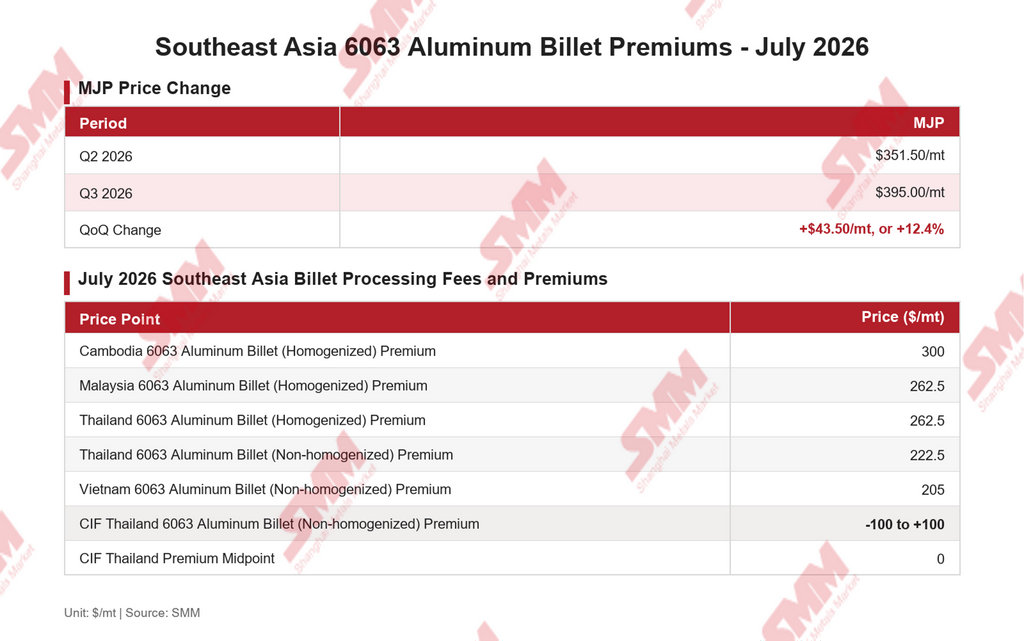
As of July 24, premiums for 6063 aluminium billet across major Southeast Asian markets remained broadly stable throughout July, with no adjustments recorded for four consecutive weeks. The ex-works premium for homogenised 6063 aluminium billet in Cambodia averaged $300/mt, while premiums for homogenised billet in Malaysia and Thailand both stood at $262.5/mt. The ex-works premium for non-homogenised 6063 aluminium billet in Thailand was assessed at $222.5/mt, compared with $205/mt in Vietnam. Meanwhile, the CIF Thailand premium for Chinese exports of non-homogenised 6063 aluminium billet was assessed at a range of minus $100/mt to plus $100/mt, with a midpoint of $0/mt. In terms of price movements, premiums for homogenised 6063 aluminium billet in Thailand and Malaysia had already retreated from their previous highs in June compared with May, before stabilising in July. However, stable premiums did not indicate an improvement in market demand. The 2026 Q3 MJP was settled at $395/mt, up $43.50/mt, or approximately 12.4%, from $351.50/mt in Q2, reaching a historical high. As reference prices for Southeast Asian aluminium billet are generally calculated based on the LME Official Cash Settlement, MJP and the applicable premium, the higher MJP further raised the overall procurement cost of locally produced billet and weighed on downstream purchasing interest. At the same time, Chinese aluminium billet exports continued to compete with locally produced material in Southeast Asia. In Thailand, for example, the CIF premium for Chinese non-homogenised 6063 aluminium billet was assessed at minus $100/mt to plus $100/mt, substantially below the ex-works premium of $222.5/mt for locally produced non-homogenised billet. Although the delivery terms and detailed cost structures of the two types of material are not directly comparable, Chinese export cargoes continued to hold a clear price advantage on a delivered basis. According to SMM market research, some Chinese export cargoes consisted of remelted secondary aluminium billet, which carries relatively lower production costs. Other cargoes were processed from imported materials before being re-exported, resulting in a cost structure different from that of conventional export trade. Supported by these cost advantages, purchases of Chinese aluminium billet in Southeast Asia increased, placing additional pressure on orders received by local billet producers. However, as aluminium billet and aluminium ingot are classified under the same aggregated HS code in existing customs statistics, it is currently difficult to quantify billet export growth separately. The assessment is therefore primarily based on feedback collected through SMM market research. On the supply side, renewed tensions in the Middle East continued to disrupt shipping routes between Asia and Europe in July, affecting exports of Southeast Asian aluminium billet to the European market. Some cargoes originally intended for Europe were redirected to domestic and neighbouring regional markets, further increasing the volume that needed to be absorbed within Southeast Asia. On the demand side, growth in local billet consumption remained insufficient to fully absorb both the surplus supply from Southeast Asian producers and the additional material arriving from China. Under the combined pressure of intensifying supply competition, elevated procurement costs and weak end-user demand, overall trading activity in the Southeast Asian aluminium billet market remained subdued in July. Although premiums across major markets had not declined further, buyers slowed their procurement pace and showed stronger bargaining intentions. Looking ahead, Southeast Asian locally produced aluminium billet premiums are unlikely to gain significant upward momentum in the short term, as the Q3 MJP remains elevated, Chinese export cargoes continue to retain a price advantage, and the region’s ability to divert supply to the European market remains constrained. The high MJP will continue to support overall billet prices. However, unless local consumption improves materially, pressure to absorb regional supply is likely to persist, while market transactions are expected to remain weak. To align with buyers’ target transaction levels and compete with the price advantage of Chinese billet exports, some Southeast Asian billet sellers may need to lower their premiums, offer concessions on MJP pricing, or adopt more flexible pricing arrangements based on the prevailing spot MJP to facilitate transactions.
This is a summary. Read the full article at the original source.
Read full article at metal_news