

(SMM Analysis) JSW Steel's Expansion Pipeline Gathers Pace as India Demand Offsets Import Pressures
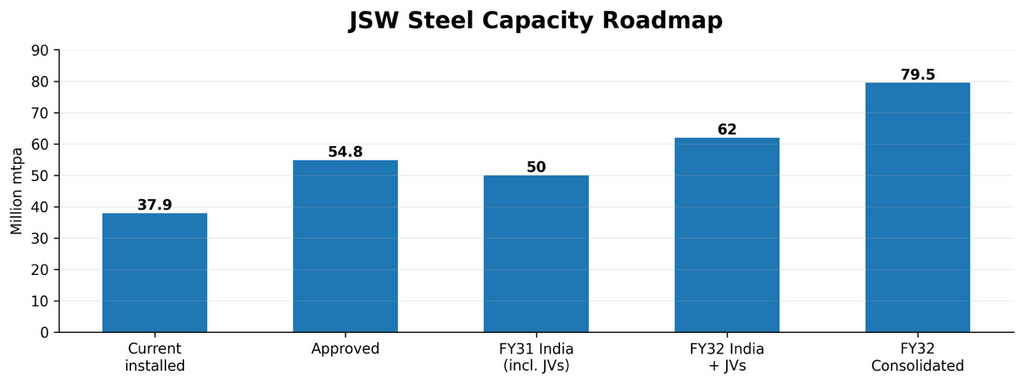
JSW Steel expects production and sales to strengthen from Q2 FY27 as the expanded Blast Furnace-3 at Vijayanagar ramps up, while reaffirming an aggressive capacity expansion pipeline spanning Dolvi, Odisha, Utkal and Kadapa. Despite the planned BF-3 shutdown, the company reported record first-quarter steel sales of 6.25 million tonnes, supported by resilient domestic demand and a 46% year-on-year increase in exports.
JSW Steel entered FY27 with strong operating performance, but the June-quarter earnings call underscored that its growth story now extends well beyond quarterly earnings. Higher raw material costs, softer long steel prices and rising imports created near-term headwinds, yet the company remained confident that India's structural steel demand will continue to support growth, backed by capacity expansion, improved raw material security and a richer product mix. The quarter marked a key milestone in JSW Steel's expansion strategy with the successful recommissioning of the upgraded Vijayanagar Blast Furnace-3 (BF-3), completion of the second tranche of JFE Steel's investment in the joint venture and continued progress across brownfield and greenfield projects. With BF-3 already ramping up, the company expects higher production from the September quarter and reaffirmed its target of reaching 62 million mtpa of Indian steelmaking capacity, including joint ventures, by FY32. The operating environment, however, has become more challenging. India's apparent steel consumption grew 8.3% year on year during the quarter, but the country reverted to being a net steel importer as imports rose 22% quarter on quarter while exports fell 16%. Higher inflows from China, Japan and Russia, together with cargoes diverted from the Middle East, drove the increase. Even so, JSW Steel expects domestic steel demand to grow 7–9% in FY27, equivalent to an additional 12–13 million mt of consumption, supported by infrastructure spending, improving private investment, manufacturing activity and resilient automotive demand. Capacity expansion remains on track Beyond BF-3, JSW Steel continued to advance its broader expansion programme, with several projects moving from planning into execution. Groundwork has been completed for the 1 million mtpa electric arc furnace (EAF) at Kadapa, scheduled for commissioning in FY29, while expansion projects at Dolvi, Utkal and the slurry pipeline remain on track. Downstream investments will add 0.44 million mt of capacity across Vijayanagar, Khopoli and Rajpura, alongside new capabilities in high-strength steels, coated products and rail manufacturing. The company also reaffirmed its long-term capacity roadmap. Future growth plans include a 10 million mt expansion at Utkal, brownfield green steel projects at Salav, further EAF expansion at Kadapa, greenfield opportunities in Odisha and Maharashtra, expansion of the JSW-JFE Steel joint venture to 15 million mt pa, and the proposed 6 million mt pa JSW–POSCO integrated steel plant in Odisha. At the same time, JSW Steel continues to increase the share of value-added and special products (VASP) to more than 50% of total sales, supported by downstream investments. Capital expenditure for FY27 is projected at ₹22,000–24,000 crore, of which ₹4,900 crore was spent during the June quarter. The completion of JFE Steel's ₹7,875 crore equity infusion further strengthened the balance sheet, reducing leverage to 1.46x and gearing to 0.42x. The company continues to target a leverage ratio below 2.5x even as investment activity accelerates. Domestic demand remains resilient despite rising imports Despite rising imports, India's demand fundamentals remain robust. Domestic steel consumption is expected to grow 7–9% in FY27, adding 12–13 million mt of demand, supported by infrastructure spending, manufacturing activity, resilient automotive sales and continued investment across commercial real estate, renewable energy, data centres, defence and maritime infrastructure. Although India reverted to being a net steel importer during the quarter, the company argued that domestic steelmaking capacity remains sufficient to meet demand. The increase in imports was attributed to higher shipments from Japan under free trade agreements, together with increased inflows from China and Russia. Ongoing anti-dumping investigations, alongside safeguard measures, are expected to play an important role in addressing unfair trade. Production Despite the planned shutdown of BF-3 for much of the quarter, JSW Steel delivered record quarterly crude steel production, reflecting the resilience of its operating platform. Higher utilisation across Indian operations largely offset the temporary outage, while the recommissioning of BF-3 is expected to support higher output from the September quarter. Excluding the shutdown, underlying crude steel production would have grown by around 15% year on year. The results suggest that future volume growth will increasingly come from new capacity rather than incremental efficiency gains, with BF-3 expected to become a key contributor through the remainder of FY27. Sales JSW Steel reported record first-quarter steel sales of 6.25 million mt, up 4% year on year from 6.01 million mt, as stronger demand for flat products offset seasonal weakness in longs. The company achieved its highest-ever first-quarter flat steel sales, with flat product volumes rising 9% year on year. Hot-rolled coil (HRC) sales increased 18%, while value-added and special products (VASP) volumes grew 8%, accounting for 61% of total sales, reflecting a continued shift towards higher-value products. Demand remained robust across institutional and manufacturing-linked segments. Institutional sales reached a record quarterly high, rising 5%, while deliveries to the automotive and renewable energy sectors increased 18% and 25%, respectively. Sales to defence, bearings, construction equipment and MSME customers also recorded healthy growth. Long products, however, experienced a weaker quarter as construction activity slowed during the monsoon. Labour shortages linked to state elections, temporary diesel availability issues arising from the Middle East conflict and increased competition from lower-priced secondary steel also weighed on demand. Retail distributors reduced inventories amid uncertainty over steel prices and geopolitical developments, although institutional demand remained resilient. With BF-3 ramping up and construction activity expected to recover after the monsoon, the company expects sales volumes to strengthen through the remainder of FY27. Financial performance Higher sales volumes, an improved product mix and stronger steel realisations helped JSW Steel deliver a resilient financial performance despite elevated coking coal and iron ore costs. Improved operating efficiencies across Indian operations also supported profitability, partially offsetting pressure from weaker long steel prices and the temporary shutdown of BF-3. The balance sheet strengthened further following JFE Steel's ₹7,875 crore equity infusion into the joint venture. Net debt reduced to around ₹45,750 crore, improving the net debt-to-EBITDA ratio to 1.46x, while gearing declined to 0.42x. Steel prices and raw materials The domestic pricing environment remained mixed during the June quarter, with flat products proving considerably more resilient than long products. HRC prices declined by around ₹1,000/mt between the beginning and end of Q1 FY27, with only limited further moderation expected in July. Healthy demand from the automotive, engineering and manufacturing sectors continued to support flat steel prices, enabling JSW Steel to prioritise higher-value flat products during the quarter. The correction was significantly sharper in construction steel. TMT bar prices fell by around ₹7,000-8,000/mt between the beginning and end of the quarter and remained under pressure into July, while wire rod prices declined by around ₹750-1,000/mt. The steeper correction reflected seasonal construction weakness during the monsoon, labour shortages following state elections, increased competition from lower-priced secondary steel and cautious buying by distributors. Temporary diesel availability issues linked to the Middle East conflict further disrupted logistics and construction activity. Despite these headwinds, institutional demand remained healthy, indicating that the slowdown was largely confined to distribution channels rather than underlying end-user consumption. On the cost side, coking coal costs increased by around US$20/mt during Q1 due to supply disruptions, higher freight rates and geopolitical tensions. Another US$12-15/mt increase is expected to flow through during the September quarter before easing from the December quarter as Australian benchmark coal prices soften. Iron ore costs also increased during Q1 but are expected to moderate later in the year as domestic supply improves following the monsoon. Freight, shipping and energy costs also rose because of the Middle East conflict, temporarily increasing delivered raw material costs. Despite these near-term pressures, the company expects steel prices and margins to strengthen during the second half of FY27, supported by lower raw material costs, the ramp-up of BF-3, the resumption of construction activity after the monsoon, continued government infrastructure spending and stronger festive-season demand. Trade and exports Although India reverted to being a net steel importer during the quarter, JSW Steel expects domestic demand to continue absorbing future capacity additions. Imports from China, Japan and Russia increased significantly, with additional cargoes diverted from the Middle East entering the Indian market. The company maintained that domestic steelmaking capacity remains sufficient to meet demand and argued that anti-dumping investigations, together with safeguard measures, will be important in ensuring fair competition. While export opportunities have become relatively less attractive as producers prioritize the domestic market, Europe is expected to remain an important premium destination following the phased implementation of the Carbon Border Adjustment Mechanism (CBAM). Higher compliance costs are expected to support regional steel prices over time, allowing efficient producers to remain competitive despite tighter environmental regulations. Outlook The company expects sequential improvement through the remainder of FY27 as BF-3 contributes higher production, raw material cost pressures gradually ease and construction activity rebounds after the monsoon. India's structural steel demand remains supported by infrastructure investment, manufacturing expansion, renewable energy, defence, data centres and automotive demand, underpinning the company's forecast of 7-9% steel demand growth in FY27. For JSW Steel, the June quarter was less a story of quarterly earnings than one of execution. With BF-3 back online, one of India's largest steel expansion pipelines progressing on schedule and domestic demand expected to remain resilient, the company's next challenge will be preserving margins amid elevated imports and volatile raw material costs while converting new capacity into profitable growth.
This is a summary. Read the full article at the original source.
Read full article at metal_news