

Think this heat is bad? Try a tornado that was 'like 15 snakes up in the air'
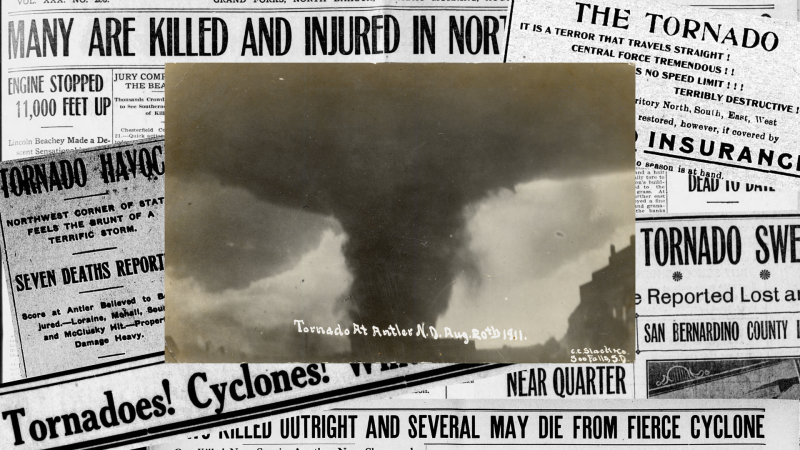
In 1911, several tornadoes ripped through North Dakota into Canada, resulting in deaths, injuries, a trail of devastated crops and homes — and one epic tornado photo.
ANTLER, N.D. — It was about 6 p.m. on a Sunday, and tiny Antler, North Dakota, was sweating on an "extremely sultry" summer day. In Manning's Grove nearby, picnickers relaxed under the shade of trees and in a creek-side dance pavilion, as heavy clouds loomed on the southwest horizon. ADVERTISEMENT It was Aug. 20, 1911. The residents of three counties in north-central North Dakota didn't yet know it, but they were about to be attacked from multiple sides by six tornadoes. The storm clouds rolled across the open plains faster than people could move. They struck across more than 40 miles of North Dakota countryside, from Sherwood to Souris, all small towns open to the wind and sky. Marveled one onlooker, reported a newspaper: It "looked like 15 snakes up in the air twisting around." Garbled reports published in newspapers across the state quickly tried to make sense of what happened. "BUILDINGS VANISH AS IF BY MAGIC," blared the Grand Forks Herald. Antler, one report went, had been "wiped off the map." What soon became clear was that the tornado barrage had devastated the area, killing some, injuring many more, and causing millions of dollars in damage in today's dollars as it tore paths of destruction through acres of crops and dozens of barns and homes. Unlike most tornadoes of its era, the largest twister would be caught on camera by an Antler photographer who stood his ground as the "fierce cyclone" bore down on his town. ADVERTISEMENT It would also make for terrifying advertisement copy for tornado insurance, warning against a menace that could strike out of nowhere: "The Python of the Skies." Tornadoes attack The funnel clouds descended like sky horrors. At Sherwood, a funnel cloud split into three — two going south, and one going north. The north twister ransacked homes and farm buildings and scattered "40 acres of oat shocks." As the two south funnels swept over the plains, two separate farm families were caught in the open. The Nelsons saved themselves by lying flat in their wheat, while the Camerons, running from their house, dropped to the ground as the funnel passed over them and "shattered" the building behind them. The tornadoes tore through the Elmer Carlson farm on Cutbank Creek, ripping apart his home, barn and granaries and scattering them along the banks of the stream. Margaret Carlson, age 3, was killed . The twisters tore up Matt Jan's shack and dumped a stove atop him, and swept through neighboring farms. Near Mohall and Loraine, farmer Ed Towne "lost his barn and several acres of grain shocks, which were sucked into the funnel shaped clouds." ADVERTISEMENT The tangle of reports made it hard to say which tornado did what. But J.H. Ronning, manager of a Westhope lumberyard, later wrote that a tornado swept from the west to north of Westhope, wrecking Neil McDougall's house so completely "it will be necessary to tear down what is remaining." It then stripped the C.O. Anderson farm of its barn, granary, and outbuildings before striking John Cook's farm until there wasn't "a stick to resemble a building on the place." Near Souris, a tornado swept through the Patterson farm, slamming a barn door into the skull of 18-year-old John Patterson Jr., killing him. Three "distinct cyclones" dropped near Antler. One swung north into Canada, and another struck the town itself but did little damage. The largest, however, came straight at Antler from the west. While others took cover in cellars, photographer W.H. Wegner, "ran for his camera and got the best cyclone picture we have ever seen," said the Ward County Independent. A 1917 federal weather review later called his first exposure "undoubtedly one of the best photographs of a tornado funnel ever published." Wegner snapped away as the funnel cloud closed to about a mile and a half, then suddenly veered northeast, just missing the town. ADVERTISEMENT But it plowed into Manning's Grove, where picnickers were desperately taking shelter under trees and inside the pavilion. The wide tornado "ruined the pavilion, tore large trees out by the roots and buried a picnic party beneath the debris." Henry Hutchins, 69, would later die of his injuries, as would 5-week-old "Baby Wright," and 22 would be injured, some very seriously. Then, as quickly as they had come, the tornadoes were gone. "It was quiet in Sherwood, the sun shone and part of a rainbow was visible in the northeast," recorded the Fargo Forum. It would take days to assess the damage and count the dead, and even longer for injured bodies to heal. The final accounting from an evening of havoc: four dead, nearly 40 injured, and more than $100,000 in damage, or roughly $3 million to $7 million today. ADVERTISEMENT "It was a real twister," said Antler Mayor J.P. Brennan, in the week's largest understatement. The aftermath Insurance agencies were quick to capitalize on what had become fearsome front-page news, in some cases running ads adjacent to casualty listings. Screamed the Minot Insurance Agency: "IT IS A TERROR THAT TRAVELS STRAIGHT! CENTRAL FORCE TREMENDOUS!! HAS NO SPEED LIMIT!!! TERRIBLY DESTRUCTIVE!!!!" Warned the Security Insurance Agency: "Cyclones drop around — they don't make appointments." An ad in the Fargo Forum listed the towns that had "suffered severely from the attacks of the 'Python of the Skies.'" The term stuck. A week after the tornadoes, a benefit baseball game in Minot featured it. "Jake Erickson's Pythons of the Skies defeated McCutcheon's South-Paws in a red hot contest held at the baseball park Sunday afternoon," reported a Minot newspaper. "The proceeds will be given to the cyclone sufferers." ADVERTISEMENT The South-Paws complained the ball was "hoodooed" — jinxed, in the era's slang — in favor of the Pythons of the Skies. Even in a benefit game, it seemed, the tornadoes were bound to win. Note: This article is based on contemporaneous reporting by the Bottineau Courant, Devils Lake World, Fargo Forum, Grand Forks Herald and the Ward County Independent.
This is a summary. Read the full article at the original source.
Read full article at dl_online